
How to Read a Blood Test Report
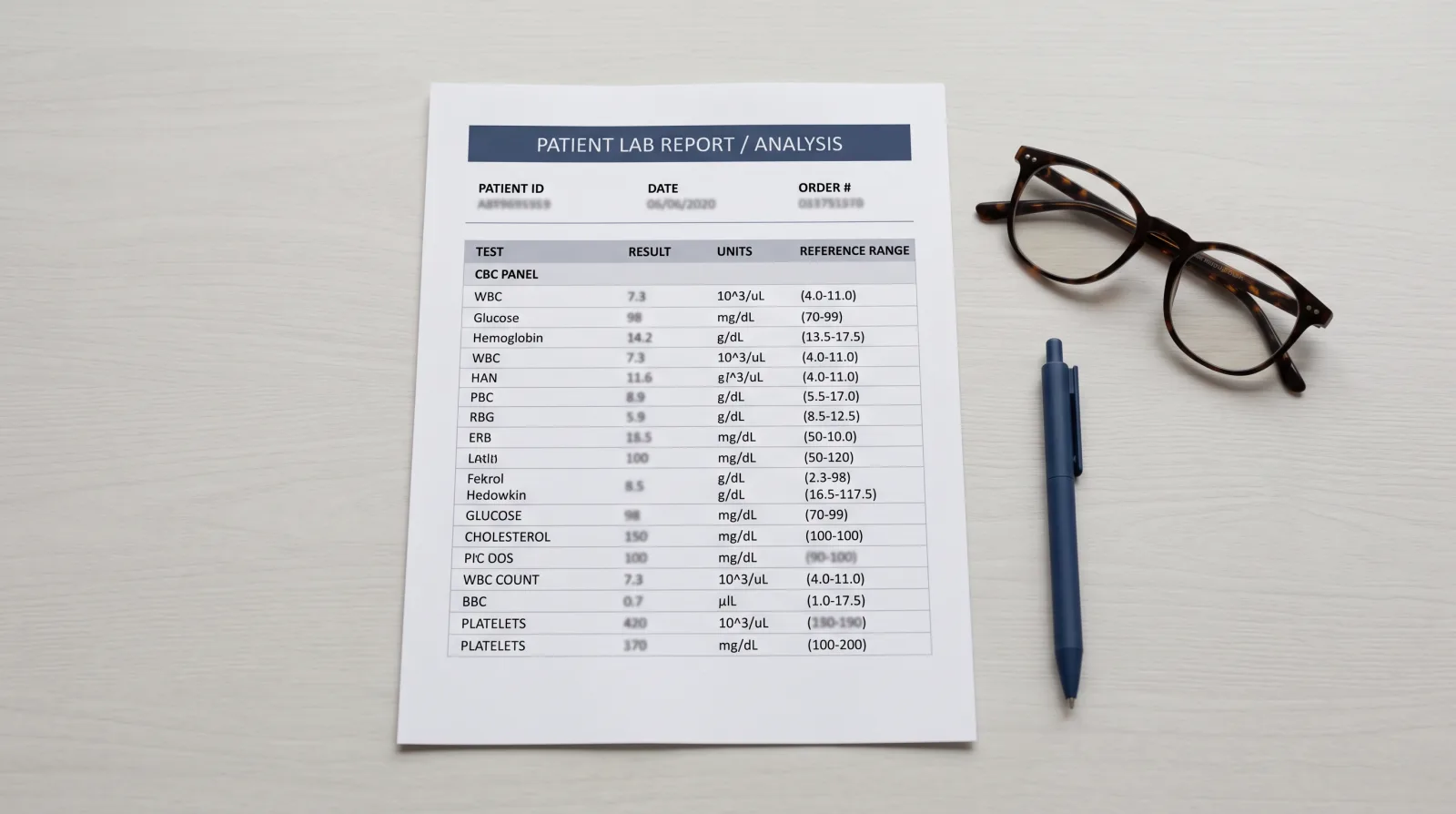
This page explains the format of a blood test report, not what your results mean. We give you access to your data — not medical advice. No clinician reviews or comments on your results before they reach you. If you have questions about your own results, take your report to your GP; in an emergency call 111 or 999.
What’s Actually on a Blood Test Report
Every blood test report — home finger-prick or clinic venous draw — follows roughly the same structure. For each marker tested, you’ll typically see four things side by side: the marker name, your value, the unit it’s measured in, and a reference range the lab compares it against. Some reports also show a flag — a symbol or letter next to any value that falls outside that range. This page walks through what each of those actually means as a piece of information — not what any specific number means for you, which is a conversation for a clinician, not a web page.
What a Reference Range Actually Is
A reference range is a statistical band, not a pass/fail line. Most UK labs build it from the middle 95% of results in a large sample of people believed to be healthy — which means, by definition, roughly 1 in 20 healthy people will have at least one result outside the “normal” range on any given test, for no meaningful reason at all. Ranges also vary between labs, between analysis methods, and sometimes between age bands or sexes for the same marker. A value flagged by one lab’s range might sit comfortably inside another’s.
None of that makes ranges useless — they’re a genuinely useful starting signal. It’s why a single flagged value, on its own, isn’t a diagnosis, and why context (your history, symptoms, and how a value has moved over time) matters more than any one number in isolation.
Understanding Flags — H, L, and Out-of-Range Markers
Most reports flag a value with an “H” (high) or “L” (low) when it falls outside the reference range, sometimes shown as an arrow or in bold instead. A flag is simply the report telling you “this number sits outside the range we compared it against” — nothing more. It doesn’t indicate severity, cause, or what (if anything) should happen next. A value can be flagged and be clinically irrelevant, and a value can sit inside its range and still be worth discussing with a GP if it’s moved a lot from a previous test, or alongside symptoms.
Measured vs. Calculated Values
Not every figure on a report comes from a direct measurement. Some — Free Testosterone and the Free Androgen Index are common examples — are calculated from other measured values using a standard formula, rather than measured directly in the sample. Where that applies on our own panels, we label it “(calculated)” so it’s clear which numbers are direct lab measurements and which are derived. Both are useful; they’re just different kinds of number.
Why the Units on Your Report Might Look Unfamiliar
UK labs report most hormones in molar units — nmol/L, pmol/L — while US labs and some online sources use mass-per-volume units like ng/dL or pg/mL. The two aren’t interchangeable without conversion, so if you’re comparing a UK report against a range or article written for a US audience, check the units line up before comparing numbers directly. Our free hormone unit converter converts between the two for 16 common hormones if you need to line up a US-format range against a UK report, or vice versa.
Getting the Most Out of a GP Conversation About Your Results
A blood test report is most useful as something you bring to a conversation, not something you read alone and act on. A few things that make that conversation more useful:
- Bring the full report, not just the flagged lines — a clinician reading a value in isolation has less to work with than one seeing the whole panel.
- If you’ve tested before, bring the previous report too — a trend across two or more tests tells a clinician more than a single snapshot.
- Note any symptoms alongside the numbers — a value’s relevance often depends on what you’re actually experiencing, not the number alone.
- If nothing is flagged but something still feels off, say so — normal-range results don’t rule out everything a symptom could be.
Frequently Asked Questions
Can I diagnose a condition from my blood test results alone?
No. A lab report gives you numbers and the ranges they’re compared against — it doesn’t diagnose anything. Diagnosis requires a clinician weighing your results alongside your history, symptoms and, often, more than one test over time.
What does it mean if one of my results is flagged?
It means that value fell outside the reference range the lab used for comparison — nothing else. It’s a signal worth discussing with a GP, not a conclusion. See “Understanding Flags” above.
Why might my result be flagged on one lab’s report but not another’s?
Reference ranges vary by lab, by testing method, and sometimes by age or sex bands, so the same value can sit inside one lab’s range and outside another’s. This is a property of ranges, not an error on either report.
Do you offer any interpretation of what my results mean?
No — our laboratory returns numbers only, with no clinical interpretation. No clinician reviews or comments on your results before they reach you. That’s a deliberate part of how the service works, not a gap in it.
Blood tests you can order
If you would rather see your own numbers than read about them, each of our at-home panels is analysed by a UK UKAS-accredited laboratory and returns your results against standard reference ranges.
- Testosterone Blood Test — total and free testosterone, SHBG and Free Androgen Index
- Male Hormone Blood Test — testosterone, SHBG, LH, FSH, oestradiol, prolactin and DHEA
- Female Hormone Blood Test — a core female hormone panel
- Thyroid Function Blood Test
- Cholesterol Blood Test
- Iron & Ferritin Blood Test
- Vitamin Deficiency Blood Test
- Athlete Performance Blood Test
- Ultimate Men’s Health Blood Test (also clinic draw)
- Ultimate Women’s Health Blood Test (also clinic draw)
- Ultimate Longevity Blood Test
Get your own numbers
Private blood testing from Optimised Lifestyle — samples analysed by a CQC-registered, UKAS-accredited UK laboratory, with your results reported against standard reference ranges. Thirteen panels from £45, finger-prick at home or clinic collection.
No clinician reviews or interprets your results — you get your own laboratory data, and this guide plus our marker glossary are here to help you read it. 18+, UK only. Not a diagnosis and not a substitute for seeing a doctor.
Related Reading
- Hormone Unit Converter — convert between US and UK hormone units
- Blood Test to Supplement — testing before you supplement, not guessing
- Blood Test Glossary — what each marker on your report is
- All Blood Tests — view the full range